Coronary Visualizer

CAG report format

A coronary angiogram report should let any reader find the culprit, the anatomy and the plan in seconds. This is the structure Coronary Visualizer drafts from the lesions you mark.

By Dr Nitharsha Prakash, interventional cardiologist · Reviewed 26 November 2026

The structure

  1. Header: name, age and sex, ID, date, access route and indication.
  2. Dominance: right, left or co-dominant.
  3. Vessel by vessel: left main, LAD, LCx and RCA, each with location (proximal, mid, distal, or the branch), percentage stenosis, and features that change management: bifurcation with Medina class, length, calcification, thrombus, total occlusion details. Write "Normal" or "Minor irregularities" rather than leaving a vessel out.
  4. Grafts, if the patient has had CABG: each graft, its target and patency.
  5. Collaterals: donor, recipient and Rentrop grade.
  6. Flow: TIMI grade where it is reduced.
  7. Impression: single, double or triple vessel disease, left main involvement, and the SYNTAX score with its band.
  8. Plan: medical therapy, PCI (with the target and device), CABG or heart-team discussion.

Example report

This is the report Coronary Visualizer drafts for the tutorial case (see the worked SYNTAX example):

CORONARY ANGIOGRAM REPORT
Name: Example patient    Age/Sex: 62/M    ID: DEMO-001    Date: 26/11/2026
Access: Right radial    Indication: Chronic stable angina, TMT positive

Dominance: Right
Left main: Normal.
LAD: Proximal to mid LAD, extending into the ostium of D1: 90% stenosis, bifurcation lesion (Medina 1,1,1), length > 20 mm.
LCx: Proximal OM1: 70% stenosis.
RCA: Mid RCA: chronic total occlusion (duration > 3 months / unknown, blunt stump, first visualised segment 4).
Collaterals: Septal collaterals from the mid LAD to the PDA, Rentrop grade 2 (partial epicardial filling).

Impression: Coronary artery disease — triple vessel disease (LAD, LCx, RCA).
SYNTAX score: 27 (intermediate). Breakdown: L1 17, L2 8, L3 2.

Plan: PCI — DES 3.0 × 32 mm to proximal to mid LAD.
      Residual SYNTAX after the planned PCI (approximate): 12.
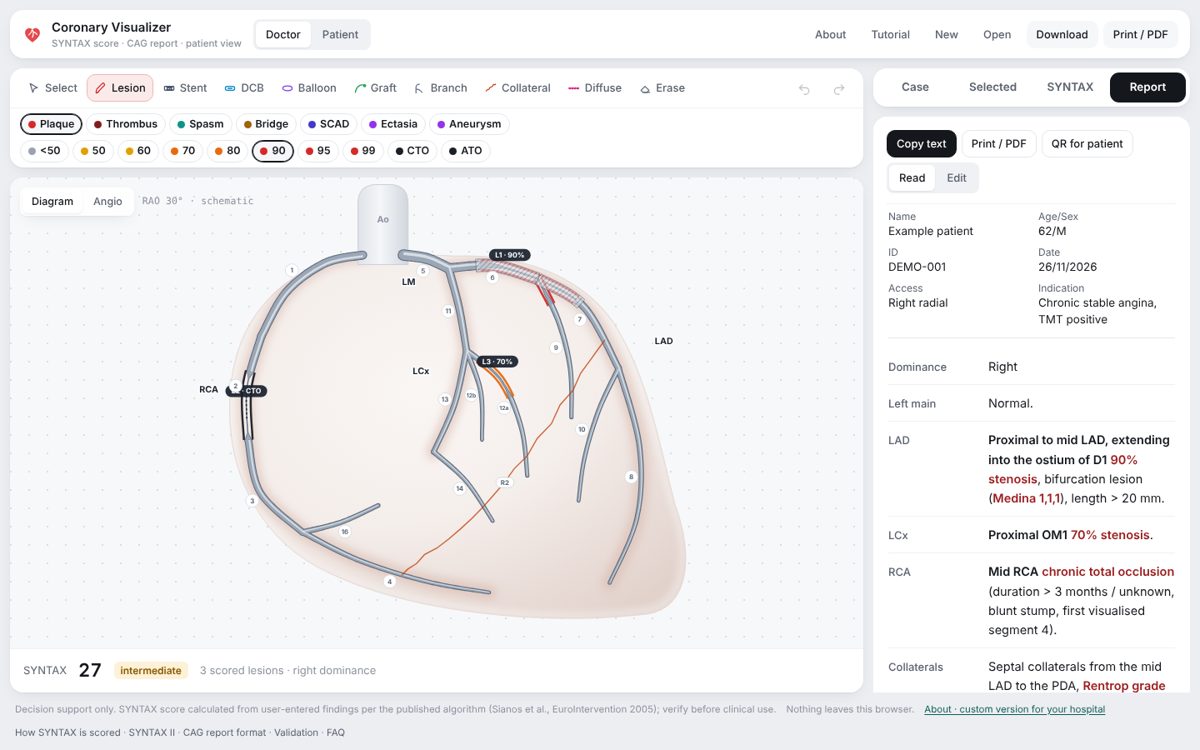
Coronary Visualizer report tab showing the drafted CAG report next to the coronary tree
The Report tab: a formatted reading view, an editable text view, and print to PDF.

Tips

  • Describe location by segment, not by distance from the ostium, so the report maps onto the SYNTAX score.
  • For a total occlusion, note duration, stump, collaterals and the first segment that fills; these change both the score and the strategy.
  • Keep the impression to one or two lines. The reader who skims should still get it.
  • Give the patient a separate plain-language summary. Coronary Visualizer creates one as a diagram they can save via QR code.

Mark the lesions and Coronary Visualizer drafts the report, ready to edit, print or save as PDF.

Open Coronary Visualizer

References

  1. Sianos G, Morel MA, Kappetein AP, et al. The SYNTAX Score: an angiographic tool grading the complexity of coronary artery disease. EuroIntervention 2005;1(2):219–227. pubmed.ncbi.nlm.nih.gov/19758907/
  2. Medina A, Suárez de Lezo J, Pan M. A new classification of coronary bifurcation lesions. Rev Esp Cardiol 2006;59(2):183. pubmed.ncbi.nlm.nih.gov/16540043/